Eating Pace

Distracted eating is not new. People have always eaten in the presence of other things: conversation, books, the view from a window, the sounds of a street. What the screen has done is not introduce distraction to the meal but radically intensify it — replacing a background of ambient experience with a foreground of competing narrative.
A book read at the dinner table occupies a portion of attention. A streaming series playing on a phone or handheld device during a meal occupies most of it. The distinction matters because the depth of attentional competition — how fully the competing stimulus engages the cognitive resources that might otherwise be attending to the meal itself — has a demonstrable relationship with how a person experiences, processes, and remembers what they have eaten.
This piece draws on published food behaviour research and field observations gathered during 2025 and early 2026 to consider what the screen-accompanied meal means for eating pace, portion awareness, and the everyday experience of food. It does not argue that eating with screens is a character flaw. It considers what the food behaviour research suggests about what happens when the meal is no longer the primary event of the meal.
One of the most consistent findings in the food behaviour research on distracted eating concerns not the eating event itself but its aftermath: the recall of it. Studies have found that people who eat while distracted — by a television programme, by a phone, by a computer — recall the meal significantly less clearly than those who eat without competing stimuli. They remember less of what they ate, in what sequence, and how much.
This matters more than it might initially appear. The body's appetite-regulating processes are not purely physiological — they are also, in part, cognitive. The memory of having eaten plays a role in subsequent hunger. Research by Brunstrom and colleagues, among others, has suggested that a meal recalled less clearly tends to generate a weaker sense of post-meal fullness and may contribute to greater intake at the next eating occasion. Eating without attention is not simply a matter of enjoying the meal less. It appears to affect the body's subsequent reckoning of what it has consumed.
"The meal that is not remembered has not, in any functional sense, been eaten. The body processes the calories but does not record the event."
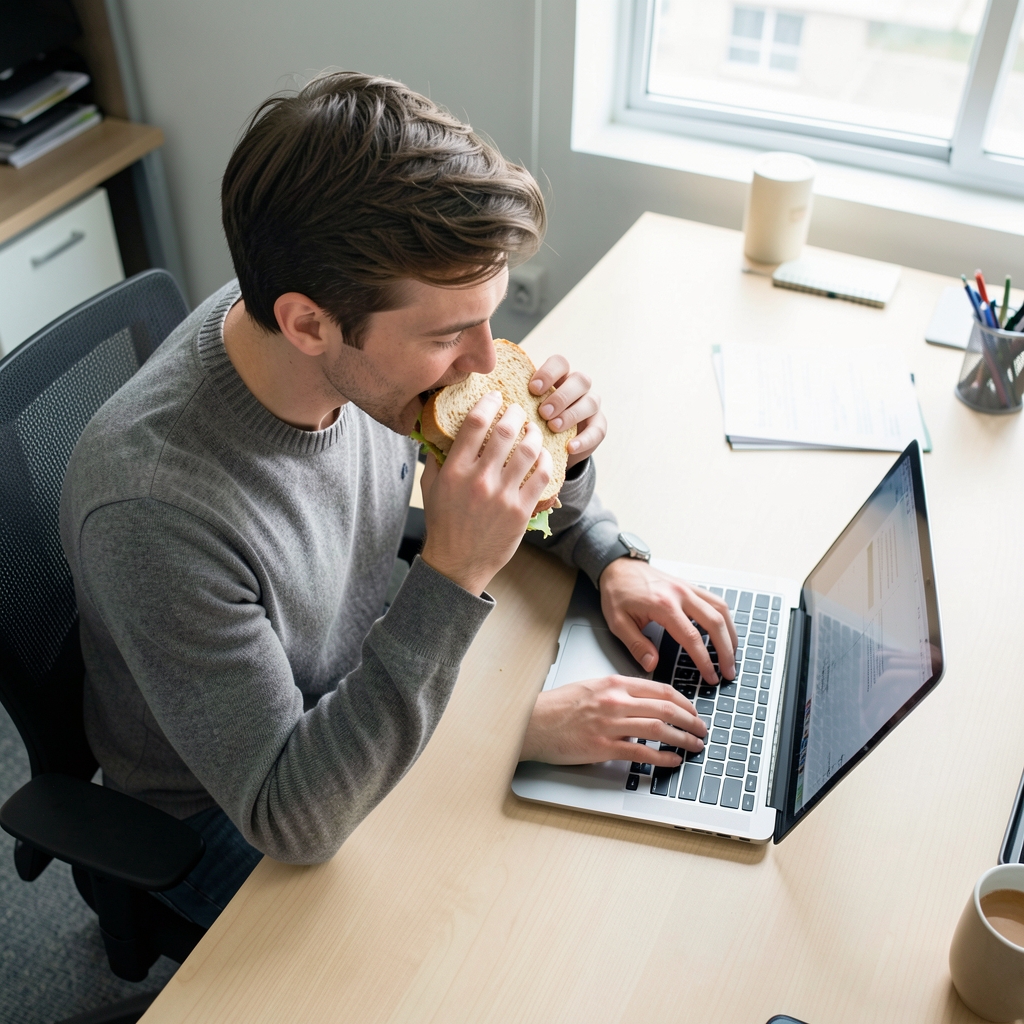
A secondary effect of screen-based distraction during eating is on pace. Food behaviour research has documented that people eating while watching video content tend to eat more quickly than those eating without competing visual stimuli. The proposed mechanism is straightforward: in the absence of meal-directed attention, the cues that ordinarily pace eating — tasting, noticing fullness beginning to develop, registering the progression of the meal — are less salient. The eating continues at a higher rate because there is less internal feedback to moderate it.
In field observations conducted in London homes and shared living spaces during 2025, this pattern was evident in near-universal form. In households where screens were present during evening meals, eating pace was substantially faster than in households where screens were absent or removed from the dining area. In the screen-present homes, it was also more common for one or more participants to take additional servings after finishing their initial plate — and for those additional servings to be taken without any particular deliberation.

Of the various screen formats present at contemporary mealtimes, the smartphone presents a particular dynamic. Its presence at the table — even when not actively in use — has been associated with a reduction in attention to the meal and to co-diners. When actively in use, its effect on eating pace and meal recall appears to be comparable to or greater than that of a television screen, despite its smaller size. The phone's attentional pull is not a function of screen area but of the personalization and unpredictability of its content: the notification, the scroll, the message are each designed to capture and redirect attention.
A smartphone used during a meal is not simply a distraction in the way that a book might be a distraction. It is an environment — a social and informational environment that makes competing demands on the cognitive resources available for the meal. Eating in the presence of a smartphone is eating in the presence of an alternative world that never fully resolves, never fully satisfies, and is always presenting one more item that might be attended to instead of the food.
The food behaviour research on mindful eating pace — broadly, the practice of bringing deliberate attention to the eating event — suggests that the attention itself, independently of what is eaten, contributes to a more satisfying eating experience. People who eat slowly and with awareness report greater pleasure in the meal, greater post-meal fullness, and greater day-to-day consistency in their sense of appetite. These are not dramatic effects, and they are not produced by any particular food. They appear to be produced by the act of attending to the eating itself.
This does not require formal practice or directed routine. It requires, primarily, the absence of something — specifically, the absence of a competing stimulus that is sufficiently engaging to redirect attention away from the meal. Removing a screen from the table, or setting a phone face-down rather than propped against a glass, constitutes a meaningful change to the attentional conditions of the meal, even if it does not constitute a transformation of the food itself.
The screen-accompanied meal is not a failure. It is an adaptation to a world in which screens are the primary medium of leisure, information, and social connection. But it is an adaptation that comes with a particular set of consequences for eating pace, portion awareness, and the recall of what has been consumed. Understanding those consequences is the first step toward making deliberate choices about when and whether the screen belongs at the table. This publication does not recommend. It records, and lets the observations speak.
People eating with screens recall their meals less clearly than those eating without, with associated effects on post-meal fullness and subsequent appetite.
Eating pace is observably faster in screen-present households and settings, with fewer natural pauses and less mid-meal adjustment to satiety signals.
The smartphone's attentional pull during a meal relates to the personalization and unpredictability of its content rather than its size or proximity.
Attentiveness during eating — independent of the food itself — is consistently associated with greater meal satisfaction and more stable appetite patterns over time.

Tobias Whitfield is contributing editor at Tarlena Almanac. His writing focuses on the intersection of technology, attention, and everyday eating behaviour. He is based in London.
More from this publication →