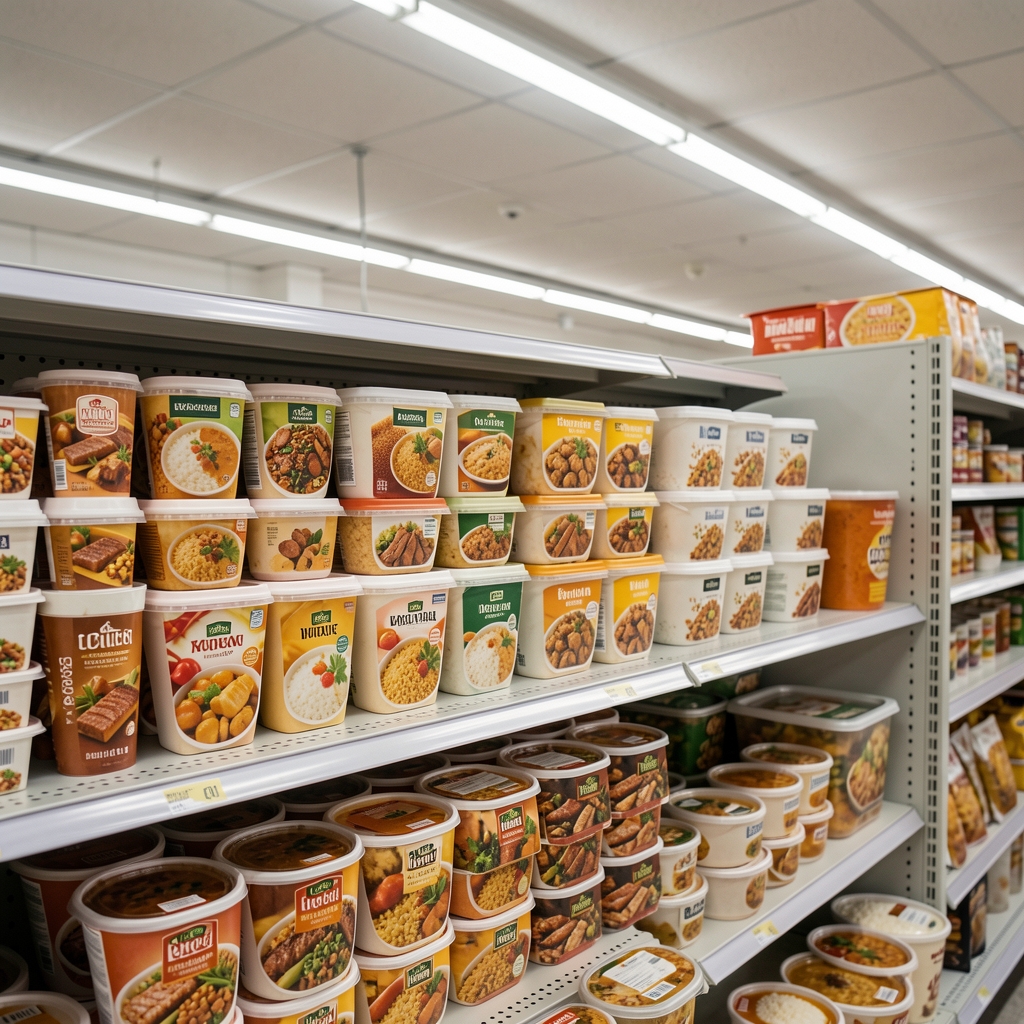
Convenience Food
There was a time, not so distant, when the midday meal was afforded its own hour. Not merely a pause in the working day but a distinct chapter of it — a transition, a reset, a moment in which something other than work could briefly occupy the foreground of attention.
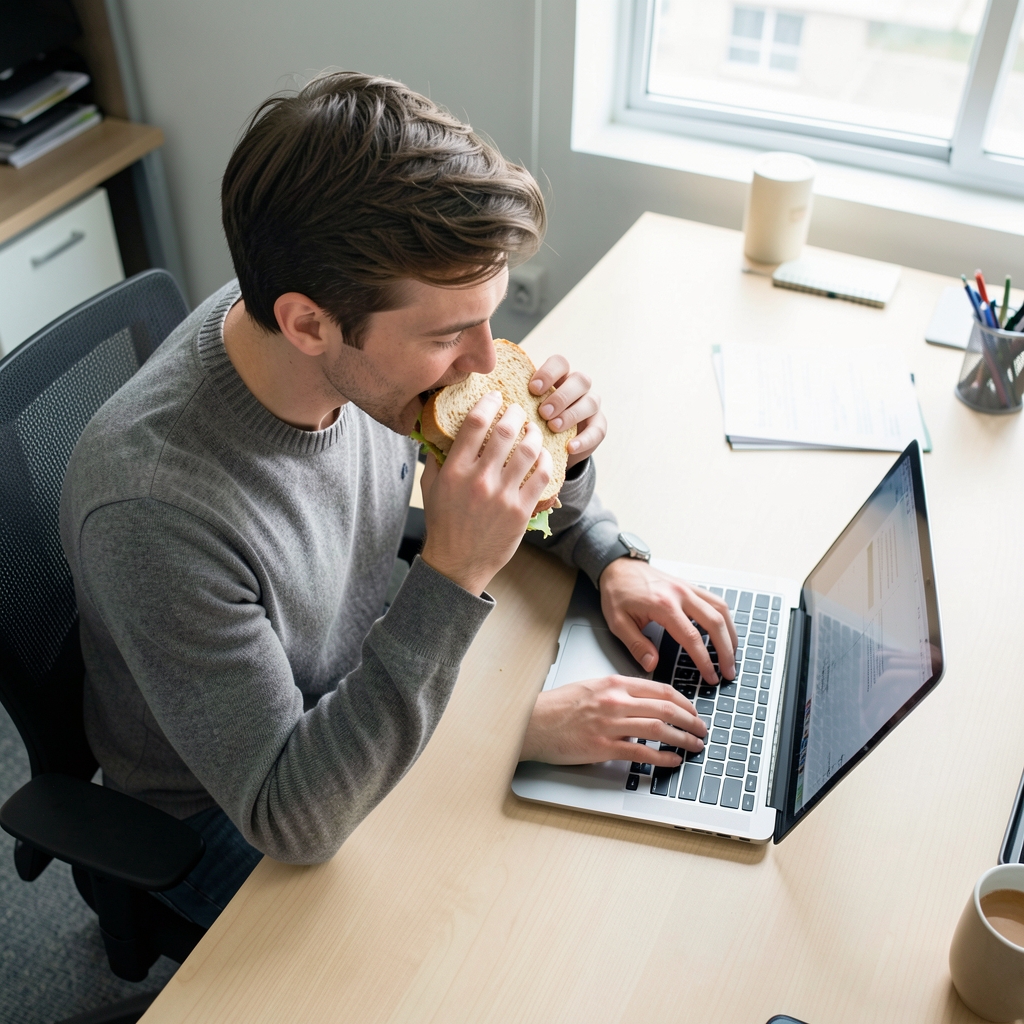
That hour has not simply shortened. In many British workplaces, it has dissolved almost entirely — replaced by a transaction. A sandwich purchased from a nearby chain, eaten at a desk with one hand while the other continues to type. A ready-made pot consumed between calls. A protein bar held in the hand during a walk between meetings. The meal, as a distinct and bounded event, has come to feel in many contexts like a luxury that most working days cannot accommodate.
This piece does not argue that the desk lunch is a personal failing, nor does it propose that workers simply ought to eat differently. What it does examine — with reference to published research on food behaviour and eating pace — is what this shift in mealtime architecture suggests about how eating pace shapes the experience and quantity of a meal. The observations come from a period of field notes gathered over several months in central London offices, cafes, and public spaces.
Research published in food behaviour and nutrition journals over the past decade has consistently shown that the speed at which a meal is consumed has a meaningful relationship with the sense of fullness that follows it. The mechanism is not mysterious: the body's appetite-signalling processes take time — typically somewhere between fifteen and twenty minutes — to communicate that enough has been consumed. A meal completed in seven or eight minutes operates almost entirely within that gap. The signal arrives after the plate is already cleared.
In a 2023 survey of British workers conducted by a major workplace consultancy, the average reported lunch duration was eleven minutes. For workers eating at their desks — the majority, by a substantial margin — the average fell to under eight minutes. These are eating sessions that begin and end before the body's own feedback mechanisms have had time to engage. The portion awareness that might ordinarily emerge over the course of a longer, more attentive meal is essentially precluded by the conditions of the eating event itself.
"The meal completed in seven minutes is not a meal that has been eaten with attention. It is a meal that has been dispatched."
During the observation period for this piece, the same individuals were watched eating in two different settings: at their work desks and, on separate occasions, in a nearby park or cafe during a longer break. The difference in eating pace was pronounced. At desks, individuals typically ate with their eyes on a screen, barely pausing between bites, finishing in under ten minutes. In the park or cafe — freed from the visual pressure of open email threads and notification badges — the same individuals ate noticeably more slowly, paused between bites, looked up from their food, and frequently left food on the plate.
This aligns with what food environment researchers have described as the "attentional competition" effect: when cognitive resources are heavily allocated to another task during eating, the ongoing monitoring of appetite and fullness is correspondingly reduced. The desk-bound lunch is not merely a faster meal — it is a meal in which the person eating it is, in an important sense, not fully present.
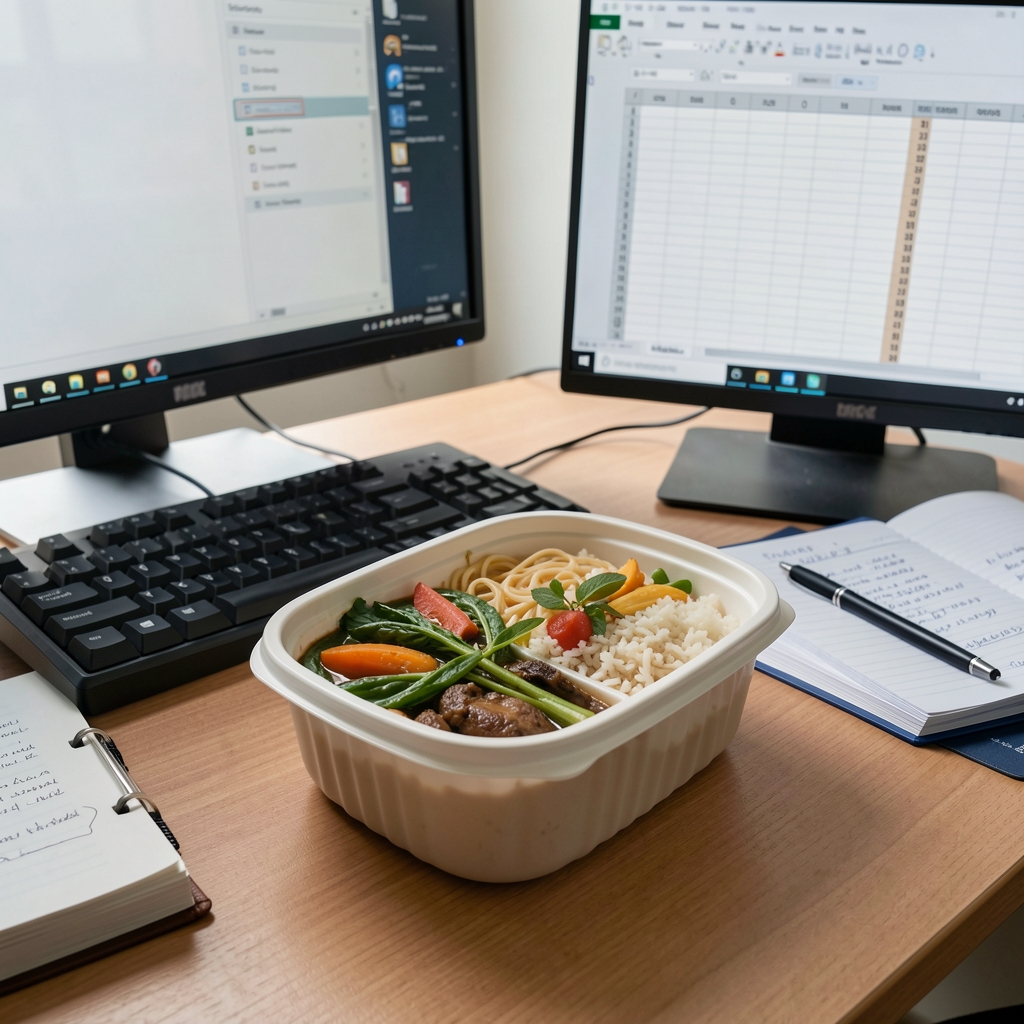
The shortening of the lunch break has its own feedback loop with the kind of food that gets chosen. When the available time for eating is ten minutes or fewer, the practical field of options narrows considerably. Foods that require table manners — that demand a knife and fork, that come in portions that need assembling — become impractical. The convenience food choice is, in this context, not a preference but a structural response to time constraint.
What is worth noting is the effect this has on portion awareness. A meal purchased as a single pre-portioned unit — a sandwich, a wrap, a prepared pot — removes the moment of portion decision from the eating event entirely. The portion is already decided, often by marketing and production conventions that may bear only a loose relationship to any individual's actual appetite or energy needs. The eater arrives at the food having already lost, in a sense, the first moment at which they might have shaped what they consumed.
This is not an argument against convenience food. It is an observation about what convenience food, consumed at pace and without attention, may obscure: the ongoing conversation between body and meal that a longer, more present eating experience allows to develop.
Among the workers observed during this study, a small number consistently ate away from their desks, even when the time available was not substantially greater. They ate outdoors, or in a separate room, or at a designated table — and they ate without a screen in their field of vision. The pace of these meals was, uniformly, slower than the desk-based equivalents. The duration was often not much longer — fifteen minutes rather than eight — but the quality of attention brought to the eating itself was observably different.
These individuals also reported, in informal conversation, a qualitative difference in the afternoon that followed. The sense of having eaten — of having paused and nourished — was more present. This is consistent with published findings in the food behaviour literature on the relationship between eating pace, attentiveness, and post-meal satisfaction: eating more slowly and with greater awareness is associated with a more satisfying eating experience and greater portion awareness over time.
The compressed lunch is not simply a nutritional event. It is a moment in the day that carries meaning about time, attention, and what we consider worth pausing for. That meaning has its own relationship with how the rest of the day unfolds — with hunger patterns, with afternoon energy, with the choices made at the evening meal. The lunch hour did not vanish without consequence. It left a gap that the body, in its own time, registers and responds to.
Average UK desk lunch duration falls below the time needed for appetite signals to engage, suggesting portion awareness is structurally reduced in these conditions.
Eating environment has a measurable effect on eating pace: away-from-desk meals, even of similar duration, proceed more slowly and with greater attention.
Convenience food choices are, in many cases, a structural response to time pressure rather than a preference — and their pre-portioned format removes the moment of portion decision from the meal.
Workers who consistently eat away from their desks — even briefly — report greater post-meal satisfaction and more settled afternoon energy patterns.

Eleanor Marsden is the founding editor of Tarlena Almanac. She has spent over a decade writing about the relationship between time, environment, and food behaviour. She is based in London EC1.
More from this author →